


WHITE PAPER

DEPOSIT PRICING STRATEGIES
in a Rising Rate Environment


Interest rates in 2022 are expected to rise faster than in the previous decade. Is your bank prepared to react?

rising-rates-web
rising-rates-icon

The expectation that financial institutions will raise deposit rates in 2022 is based on a recovery and expansion scenario.

Introduction

Current market forecasts suggest that we will soon see Fed funds, and subsequently, retail and commercial deposit rates, rise in 2022. Banks are anxious to see an expansionary rate regime to push open net interest margins and thus, signal the improving demand for loans. Tepid loan demand and rock-bottom margin spreads have been an anchor on bank earnings over the past year and we are collectively anxious to return to a more traditional rate curve.

Inflation has been prevalent across news and media headlines lately, and for good reason. Supply chains remain somewhat disrupted due to Covid-19 adaptations, the demand for goods is rising, and there is excess liquidity in the money supply. Together, these three forces are lifting prices higher. On the one hand, recent growth in core consumer prices, commodities, equity values, and real estate prices give concern that the market is exuberant. On the other hand, unemployment remains fluid. The current trajectory of the economy could be an indication that we are getting “back on track.”


ARTICLE CONTENT:

A Look at the Current Environment

The expectation that financial institutions will raise deposit rates in 2022 is based on a recovery and expansion scenario. However, circumstances in this rate cycle are unique from previous cycles. The amount of free cash currently held in depository institutions is unprecedented. In a normal rising-rate environment, one would expect to see depository institution rates moving in earnest after the Fed funds rate makes 100-150 basis points of movement. While the industry may see some upward rate movement from central banks in the medium term, the existing overabundance of funding and low loan demand, if exacerbated by a future bearish economy, could result in a lack of federally insured institutions making meaningful rate movement before central banks are forced to cut rates again.
projection-rate
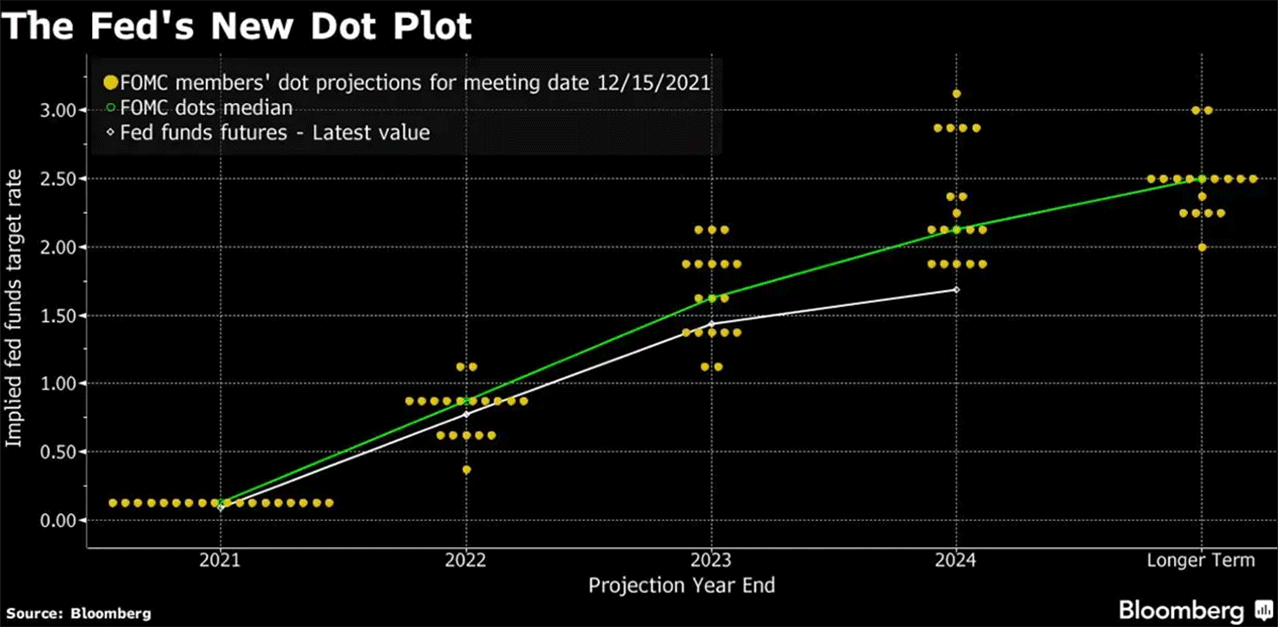
The “Dot Plot” exhibits strong consensus for rates to increase in 2022 by 75-100bps and will continue to rise until 2024 given current economic trends. Source: Bloomberg

So, what are financial institutions to do in light of limited opportunity to gain yield via margin expansion, especially while options for an expansion in fee income via punitive fees are restricted? Mortgage and wealth management fees are a popular strategic focus when margins are compressed, but these fees are sensitive to the rate cycle and the space continues to get more and more crowded by non-bank participants. It is also important to note that the necessity of expanding brand awareness and improving the digital experience has precipitated a wave of merger announcements over the past three years, and it is expected that this trend will continue as long as regulators permit. One must also be mindful of the persistent and somewhat urgent focus on deepening relationships and thus, achieving a greater share of wallet.

While this focus is nothing new, there has been an obvious shift and additional attention on leveraging robust technology and actionable data to better understand clients and specifically tailor pricing, rewards, and offers to their unique situation. Further, with fewer transactions taking place in the branch, banks are using technology and data to replace the contextualized service that was once provided by a smiling banker.

Banks that succeed in creating a rich and personalized experience will be able to gain a sufficient share of wallet and scale amid the ups and downs of rate cycles. The financial institutions that are too slow to adapt or are unable to allocate necessary resources to embrace this shift could find themselves as a good target for a merger or acquisition.

Back to Top

When Will Deposit Rates Rise Again?

From media stories and government reports on core and non-core inflation rates, to neighbors bemoaning the cost of a trip to the lumber store or car dealership, our lives have been flooded with tales of inflation. In one way or another, we all have experienced the effects of an ample money supply and shortages, as well as an increased demand for goods.

In its effort to tame inflation at full employment, the Fed is expected to implement a first rate hike of 25-50bps as early as April. In the later parts of 2022, we should see an additional three rate hikes which means the Fed rate is likely to increase by 100-150bps by year’s end.

Back to Top

How Can Banks React to Rapidly Rising Rates?

Banks, especially those who have asset-sensitive balance sheets (i.e., several variable-rate loans tied to Prime, LIBOR or SOFR) realize an immediate boost to earnings whenever rates rise. The excess of deposits, both in the system and at the institution level, means that banks will not need to seek additional funding to meet loan demand.

Different banks will have varying strategies to react to rising rates depending on their current loan-to-deposit ratios, FTP rates and rate movements of their relevant competitors. While determining the ideal Beta is a tactical decision, all banks should be considering the below strategic factors to prepare themselves for the rising rate environment.

  • Rising Rate Regime Models

Forecasting models typically rely on historical data to identify trends and sensitivity in the portfolio to predict future balance flows. The last two years have been a flat-rate environment with a strong customer preference for liquid products due to market volatility. Models that are trained using this data can produce inaccurate and irrelevant results and should be avoided when using predictive analytics to make rate decisions in a rising rate environment. Robust models that offer rate environment and COVID impact input levers, are better suited to capture the price elasticity and emerging trends of previous rate environments. Enhancing the model accuracy is essential to gaining a competitive advantage when building out pricing strategies.

  • Relationship Pricing

Customer-level segmentation attributes including, direct deposits, bill pays, tenure, lending relationship and engagement with digital channels, will help identity loyal customers who are also typically less price-sensitive. Incentivizing customers through onboarding programs and personalized offers and pricing, will drive increased customer primacy and lower price sensitivity in the deposit portfolio. This approach allows the ability to lag or offer a lower Beta as Fed rates rise to maintain a higher NIM and protect balances from attrition.

  • Mining Transactional Data

Transactional data can be leveraged to add more granularity to the flow-of-funds analysis and to better differentiate between price-driven and recurring outflows. The outflow of money from a competitor rate change is a vastly different transaction compared to recurring mortgage payments. Built-in capabilities that can identify the difference should be incorporated into deposit modeling improving the prediction of rate-driven balance movements in a rising rate environment.

Back to Top

Limited Rate Increases Have Already Begun

Due to consumers’ aversion to locking up money in term deposits, the industry has seen an increasing flow of deposits out of term products into liquid. Further, some portfolios of term deposits fall between 60% and 90% of the balances they had just over a year ago. Meanwhile, liquid deposits are 125% to 175% of where they were a year ago. Many banks find the imbalance uncomfortable and are making efforts to slow or stop attrition in the term deposits book. This has led to increases in term deposit rates and in a limited number of cases, even rate specials. Banks that prioritize rebalancing the mix of deposits should consider introducing a medium-term Bump product, or potentially restructure early withdrawal penalties to make mid-/long-term deposits less intimidating.

Back to Top

Concluding Thoughts: Lower For Longer

We are poised to enter a rapidly increasing rate environment and it’s clear that waiting for NIM expansion will not improve your bank’s performance today. Rather, the ability to deliver personalized, contextual rates and offers to clients in both deposits and lending will separate the new “relationship” banks from those of the past. Customer expectations have increased for what banks can and should deliver, both proactively and reactively as their needs change. Banks will need to be more creative and customer-focused to drive deeper relationships, gain share of wallet and reduce the cost of acquisition for customer balances.


Access and download the Deposit Pricing Strategies white paper PDF file.
Original publication date: February 2022.

Learn More

The competition for customers and share of wallet continues to increase at a rapid pace. To win, leading banks and lenders rely on Nomis’ best-in-class technology to gain operational control, increase agility, and compete more effectively. Contact us to see how our customer-centric pricing applications can improve the customer experience and assist in your organization's financial gain.

Back to Top